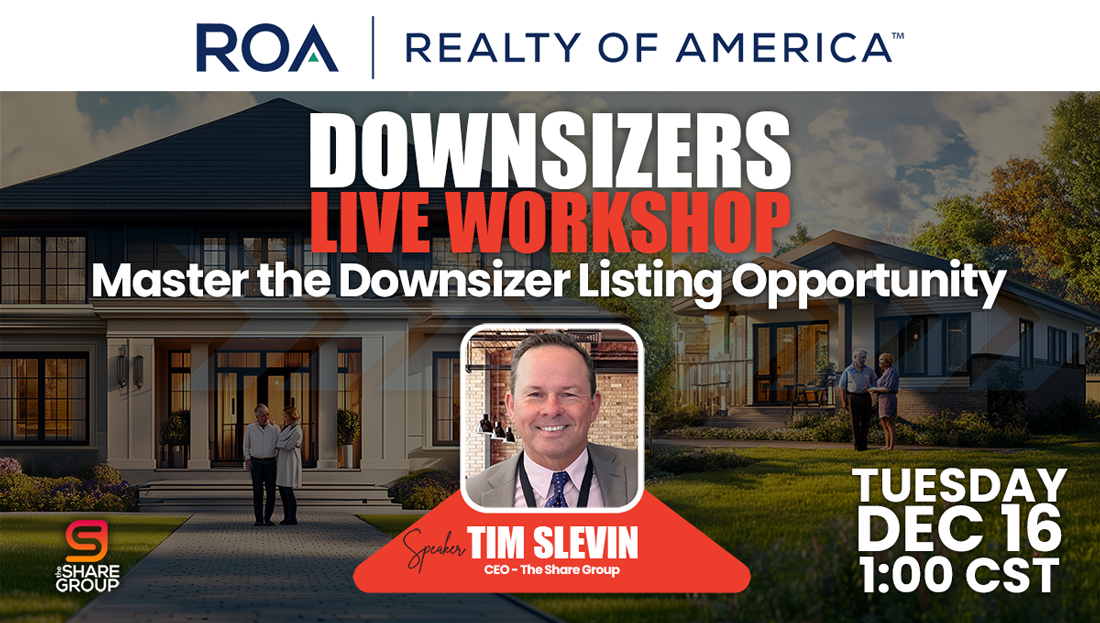
Webinar highlights and field-ready tactics from Tim Slevin (CEO, The Share Group) | Recorded December 16, 2025
Downsizers are one of the cleanest seller segments to target because they are easy to identify, usually equity rich, and often motivated by life changes that create a real “when” (not just “if”) around moving.
In our ROA (Real Estate of America) workshop, Tim Slevin broke down what defines a downsizer, why this segment is set up to drive listings in 2026, and how agents can build a predictable pipeline with a simple, repeatable top-of-funnel process.
What is a “downsizer” and why does it matter now?
A downsizer is typically:
- Age 62+ (often 65+)
- High equity (commonly 80%+ equity or free and clear)
- Long tenure (15+ years in the home)
- Empty nester lifestyle shift (kids are grown and gone)
- A home that no longer fits their life (too large, too much upkeep, stairs, second-floor primary, etc.)
Why this matters right now: the typical age of home sellers is 64, the highest ever recorded, according to NAR’s 2025 Profile of Home Buyers and Sellers. nar.realtor
That means “older homeowner” is no longer a niche. It is increasingly the center of the seller market.
The “top-of-funnel” truth agents need to embrace
This is not a same-week listing play. It is farming with intent.
Tim described downsizers as a top-of-funnel strategy where your target timeline is:
- 3 to 9 months from first contact to listing
- With an “evergreen” compounding effect once your follow-up system matures
The win is that you are not guessing who might sell. You are stacking the odds by focusing on people with a higher likelihood to move as time passes.
The stat that changes how you prospect
Instead of calling 10,000 random homeowners, demographic prospecting narrows your list to the best 3,000 to 3,500 to call first.
Tim referenced a practical conversion shift:
- Traditional broad prospecting: can feel like 50 conversations to 1 quality lead
- Demographic prospecting: can compress to 10 conversations to 1 quality lead
The takeaway: same effort, better targets, more predictable outcomes.
Why downsizers are more “winnable” than most agents realize
Two key reasons came up in the session:
1) Older sellers are less referral-driven than younger buyers
As people age, their “active network” of working professionals often shrinks. That opens the door for agents who show up consistently and professionally.
2) Many sellers do not shop agents the way agents assume
Multiple industry summaries of NAR data indicate around 80% of sellers contact only one agent before choosing who to work with. bnar.org
Whether that number is 80% or 81% in a given year, the strategy is the same:
Your goal is to become the first serious agent they talk to when the timing flips.
What downsizers actually want (and what stops them)
Common motivations to move
Tim outlined motivations you can build your messaging around:
- Cashing in equity to fund retirement lifestyle
- Lower monthly expenses and lower maintenance
- One-level living (health, mobility, stairs)
- Moving closer to kids and grandkids (jobs pull families away)
- Better healthcare access and lifestyle amenities
- A neighborhood that no longer “fits” (peers moved, community changed)
The hidden friction: fear and uncertainty
Downsizers often hesitate because:
- They are emotionally attached to a paid-off home
- They fear trading “repairs when needed” for a fixed monthly cost
- They worry about running out of money (even if financially secure)
- They fear change until a life event forces urgency
Your follow-up system exists to patiently bridge that gap until the moment they say, “Okay, it’s time.”
Outreach that works best for downsizers
1) Telephone prospecting (best channel)
Why it works:
- They still answer phones more than most segments
- They respond to politeness, patience, and respect
- A real conversation beats a digital click for trust-building
A strong tactic Tim shared:
- Call to introduce yourself
- Offer something simple and non-pushy like: “I’d be happy to drop off a CMA.”
- Use that as a reason for a face-to-face handshake (trust accelerator)
2) Direct mail (strong support channel)
Why it works:
- Name familiarity increases call and conversion rates
- Works well in higher price point areas where ROI math is easier
- Helps your later calls land better: “Oh yeah, I’ve seen you.”
Tip from the Q&A: simulated handwritten often performs like a high-response hybrid without being impractical at scale.
3) Email (least effective for this segment)
Tim’s take: scams and spoofing have reduced trust. For downsizers, personal channels outperform.
The daily activity target: simple, measurable, predictable
Tim emphasized building a predictable pipeline by setting daily conversation goals, not vague “I’ll prospect more” intentions.
A practical framework mentioned:
- Aim for 5 to 8 quality conversations per day
- Treat it like a dial-based business plan where inputs create outputs
He also referenced a worksheet approach where you plug in:
- Dials per day
- Contact rate assumptions
- Days per week
- Expected annual outcomes
The point is not the exact math. The point is: you can engineer consistency.
Why right now (late December) is a sneaky advantage
Tim called out the holiday window as a real opportunity:
- Many agents “check out” between Christmas and New Year’s
- Many homeowners are home, less busy, and more available to talk
- Online real estate browsing can spike during that downtime (people thinking ahead)
In other words: less competition + more access.
A simple 30-day plan to start your downsizer pipeline
Week 1: Define your “downsizer farm”
- Pick 2 to 5 ZIP codes (or neighborhoods) you actually want listings in
- Prioritize long tenure + high equity + age signals
Week 2: Start conversations (don’t sell)
- Call with a curiosity-based opener
- Offer value (CMA, neighborhood snapshot, “here’s what homes like yours are doing”)
- Tag the contact in your CRM for downsizer follow-up
Week 3: Layer mail
- Send a simple postcard to the same farm
- Keep it human: your face, your name, one clear message, one clear way to respond
Week 4: Follow-up rhythm
- Light touch, consistent cadence
- Quarterly check-ins are often enough for this segment, as long as you stay remembered
ROA agent resources mentioned in the webinar
Tim shared that ROA agents can access:
- A downsizer toolkit (scripts, clips, videos)
- A calls-to-closes calculator
- ZIP code and county-level downsizer counts (stack-ranked)
- One-on-one support to build a custom “recipe” for your market
-
Register for a free ROA Lead Store account: https://shop.theshare.group/sign-up?sf=roa
-
Request the Downsizer Toolkit: Click Here
-
Schedule a strategy call: Click Here
Final takeaway
Downsizers are not a hack. They are a demographic reality.
If the typical seller is now 64 nar.realtor and first-time buyers are a historically smaller share of the market (21% in NAR’s 2025 profile) nar.realtor, then the agents who build a repeatable system for older, equity-rich homeowners are building a pipeline that can last for years.
This is “relationship warm-up time.” Make the calls, stay consistent, and be the first agent they think of when life changes.
FAQ
How long does it take for downsizer leads to turn into listings?
- Expect 3 to 9 months on average, with some faster wins when life events accelerate timing.
What’s the best first offer to make on the phone?
- A low-pressure value offer like a CMA drop-off or a quick “here’s what homes like yours are selling for” conversation.
Should I focus on mailers or calling first?
- Calling first is usually stronger for trust. Mail works best as reinforcement and familiarity, especially in higher price points.
What’s the biggest mistake agents make with downsizers?
- Pushing for an immediate listing instead of building trust and staying in follow-up long enough for timing to mature.