
Skip to content
Absentee OwnersMOST POPULAR
An Absentee Owner owns a property but doesn't live there. This term usually refers to owners of vacant properties, not just landlords or rental owners.
Distressed Homeowner Leads
Distressed Homeowners, also known as pre-foreclosure, are residential properties where the owner has shown signs of being unable to keep up with financial obligations.
Divorced Leads
Divorced households are typically highly motivated to sell. The urgency often stems from the need to divide assets promptly, making timing a critical factor.
Likely-to-Sell Leads
Our Likely-to-Sell leads uses factors like home equity, residence length, home value history, and demographics to find ideal candidates ready to sell.
Downsizer / Empty NestHOT
Downsizers, or Empty Nesters, offer great listing opportunities. With large, paid-off homes, they seek smaller properties and often pay cash.
Mortgage LeadsNEW
We offer high-quality mortgage leads with advanced segmentation, allowing for highly targeted outreach. Our leads are refreshed regularly to ensure you connect with active, engaged clients.
Realtor LeadsNEW
Realtor Leads include verified contact info - such as realtor name, phone number, email address, company and gross annual sales volume to help you accelerate business growth.
Timeshare LeadsNEW
Timeshare Leads include verified owner data - including name, mailing address, property location, ownership length, age, and income filters to help you target motivated sellers and drive results.
Search Your Market - It's Free and Only Takes 2 Minutes! - Sign Up Today
4 Real Estate Lead Types You’ve Never Heard Of in 2026
TheShareGroupMay 5, 2026 1:01:59 PM5 min read

4 Real Estate Lead Types You’ve Never Heard Of (But Should Work in 2026)

4 Real Estate Lead Types You’ve Never Heard Of (But Should Work in 2026)
7:18

If you’re relying on referrals, past clients, and inbound leads alone, you’re competing in the most crowded part of the market. The agents pulling ahead in 2026 are doing something different - they’re targeting homeowners before they raise their hand. This guide breaks down four high-opportunity seller segments and how to actually convert them into conversations, appointments, and listings.
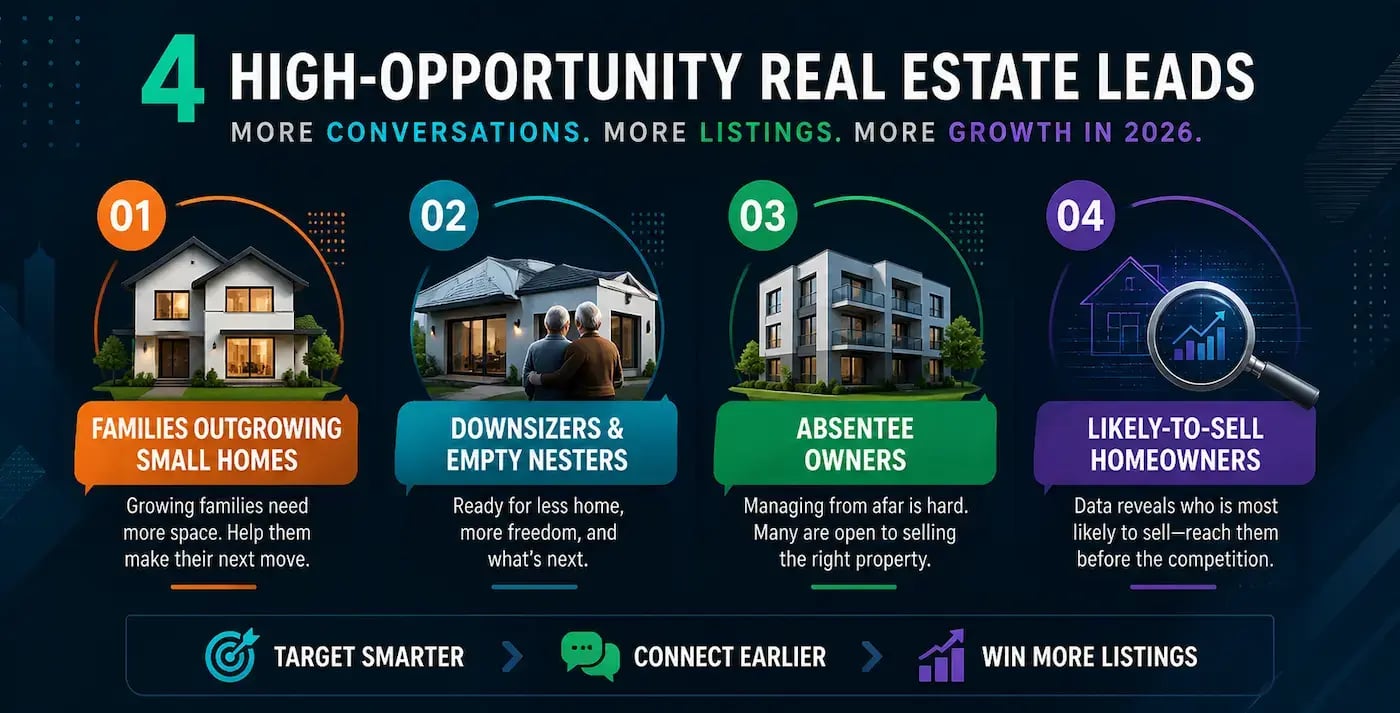
4 Real Estate Lead Types You’ve Never Heard Of  2026


Why Lead Strategy Matters More in 2026

The market has shifted:

  • Lead costs are higher
  • Conversion timelines are longer
  • Competition for “obvious” sellers is intense

At the same time, data quality and targeting have improved. That creates a gap:

  • Most agents still chase high-intent leads
  • Top performers build pipelines from top-of-funnel homeowners

Industry coverage from Inman consistently points to a simple reality - consistent outbound to targeted homeowner lists outperforms relying on inbound alone.

The opportunity is to start earlier.


The 4 Lead Types That Are Working Right Now


1. Families Outgrowing Small Homes (The Hidden Move-Up Market)

Initializing map...


What’s happening

Over the last few years, many buyers compromised:

  • Bought smaller homes due to inventory constraints
  • Delayed moving because of interest rates
  • Settled for “good enough” space

Now life is catching up:

  • Kids are older
  • Remote work is sticking
  • Space limitations are real

This creates a large segment of homeowners who:

  • Purchased 3 to 7 years ago
  • Have gained equity
  • Are feeling the pressure to upgrade

Why this segment converts

  • Motivation is emotional and ongoing
  • They become both a seller and a buyer
  • They are early-stage - less competition

How to identify them (data signals)

  • Ownership length: 3–7 years
  • 2–3 bedroom homes in family-heavy areas
  • Increasing home values
  • Demographic indicators (growing households)

Messaging that works

Avoid “Are you selling?”

Instead, align with what they’re feeling:

“A lot of families I talk to right now are realizing they’ve outgrown their space - even if they weren’t planning to move this year.”

Common mistake

Waiting for them to inquire.

By then, you’re competing.


Want to see how many of these leads are available in your area?

You can check live lead counts inside the Lead Shop here →


2. Downsizers & Empty Nesters (The Equity-Rich Transition Sellers)

What’s happening

This is one of the largest wealth segments in real estate:

  • 15–30+ years of ownership
  • Significant appreciation
  • Lifestyle shifts toward simplicity

These homeowners are:

  • Not in a rush
  • Not distressed
  • But increasingly open to change

Why this segment converts

  • High equity = easier decisions
  • Lower urgency = better conversations
  • Planned moves = smoother transactions

How to identify them

  • Ownership length: 15+ years
  • Larger homes than needed
  • Age and life-stage indicators
  • Low or no mortgage balance

Messaging that works

This group doesn’t respond to pressure.

They respond to planning:

“A lot of homeowners in your position are starting to explore downsizing options - even if it’s 6 to 12 months out.”

Common mistake

Pushing urgency instead of offering guidance.


3. Absentee Owners (Consistent, Logical Sellers)

What’s changed in 2026

  • Rising maintenance and management costs
  • Regulatory pressure in rental markets
  • Landlord fatigue
  • Portfolio repositioning

Absentee owners are often:

  • Financially motivated
  • Less emotionally tied
  • Open to exploring options

Why this segment converts

  • Logical decision-making
  • Higher openness to conversation
  • Earlier engagement window

How to identify them

  • Owner mailing address ≠ property address
  • Rental indicators
  • Equity position
  • Multi-property ownership

Messaging that works

Lead with ease and optionality:

“If managing that property ever starts to feel like more work than it’s worth, I can show you what selling would look like in today’s market.”

Common mistake

Sounding like a pitch instead of a resource.


4. Likely-to-Sell Homeowners (Predictive Data Advantage)

What’s different now

You no longer have to guess.

Predictive modeling uses:

  • Ownership duration
  • Equity levels
  • Property characteristics
  • Life-stage indicators
  • Behavioral trends

Why this matters

Better targeting leads to:

  • More conversations per hour
  • Higher contact rates
  • Stronger pipelines

How to identify them

This comes from layered data models, not a single filter.

Messaging that works

You’re not calling a “seller.”

You’re calling someone approaching a decision:

“We’re seeing more homeowners in your area starting to make moves this year - I wanted to share what’s happening locally.”

Common mistake

Using high-pressure scripts on low-pressure prospects.


How These Lead Types Work Together

Each category hits a different angle:

Together, they create a balanced, scalable pipeline.


The Real Advantage in 2026: Starting Earlier

Most agents wait for:

  • Form fills
  • Inbound inquiries
  • “Ready now” sellers

That creates:

  • Competition
  • Higher costs
  • Lower control

Top agents:

  • Start conversations earlier
  • Build familiarity before the decision
  • Create predictable listing pipelines


Simple Execution Plan (What to Do Next)

You don’t need complexity.

You need consistency.

Step 1: Choose 1–2 segments to start

Don’t overcomplicate it.

Step 2: Build a clean list

Target quality over quantity.

Step 3: Call consistently

  • 2–3 hours per day
  • Track conversations, not dials

Step 4: Use simple messaging

No scripts. Just relevant conversations.

Step 5: Follow up

Most conversions happen over time.


Final Thoughts

There’s no shortage of leads in real estate.

There’s a shortage of:

  • Targeting
  • Consistency
  • Strategy

If you focus on:

  • Families outgrowing homes
  • Downsizers
  • Absentee owners
  • Likely-to-sell homeowners

You’re not just finding more sellers.

You’re finding them:

  • Earlier
  • With less competition
  • With better conversations


Frequently Asked Questions (FAQs)

What is the best lead type for real estate agents in 2026?

There isn’t a single “best” lead type. The most effective strategy combines multiple segments like upsizers, downsizers, absentee owners, and predictive sellers to create a consistent pipeline.


How do I find homeowners who are likely to sell?

You can use data providers that combine ownership, equity, demographic, and behavioral indicators to identify homeowners with a higher probability of selling.


Are absentee owners still good leads in 2026?

Yes. In many cases, they are even more motivated due to rising costs, regulation, and landlord fatigue.


How long does it take to convert these leads?

These are top-of-funnel leads. Some convert quickly, but most require consistent follow-up over weeks or months.


Should I stop buying inbound leads?

No. The best approach is to layer outbound prospecting on top of inbound, not replace it.


Closing

If you want access to targeted homeowner data built around these exact segments - including absentee owners, downsizers, and likely-to-sell homeowners - you can explore available leads in your area inside the Lead Shop.

Or reach out and we’ll help you identify the best opportunities based on your market.

 

COMMENTS

RELATED ARTICLES