
Absentee Owners
An Absentee Owner owns a property but doesn't live there. This term usually refers to owners of vacant properties, not just landlords or rental owners.

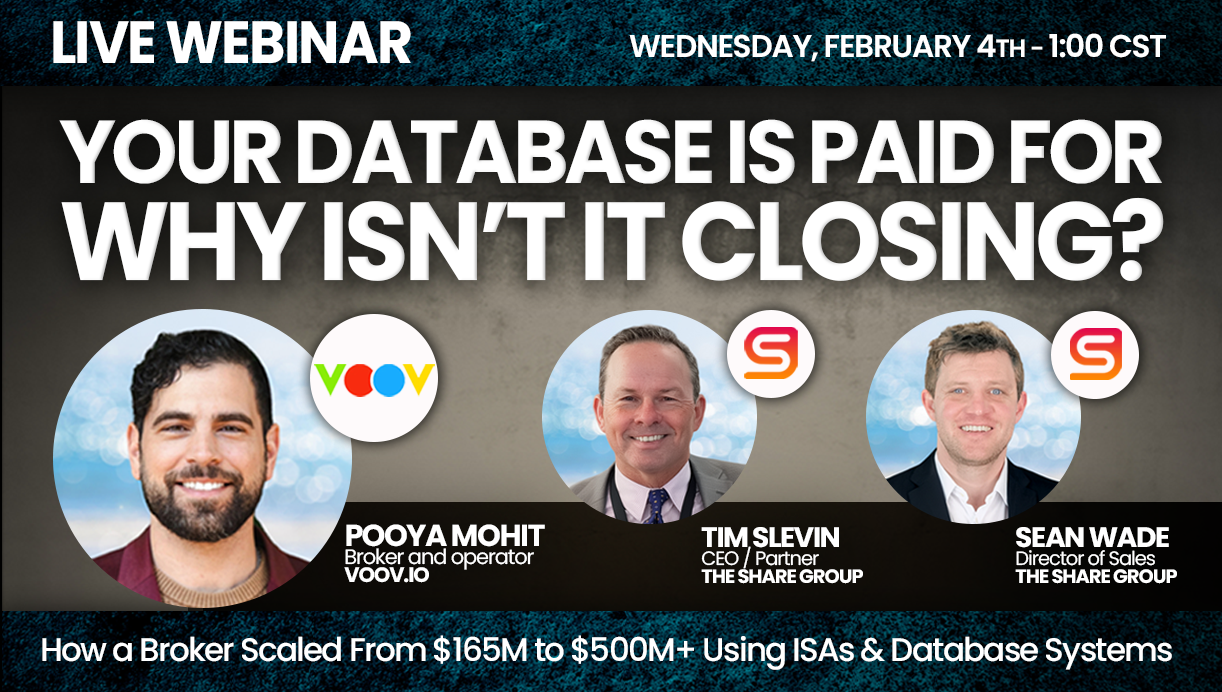
Yesterday’s webinar (02/04/2026) was a real-world conversation about a problem almost every agent and team has felt:
You’ve invested in leads, you’ve built a database… and then “life in the business” takes over. Active deals get the attention. The database gets neglected. And the hidden cost is missed listings, missed referrals, and missed timing.
Tim Slevin (CEO, The Share Group) was joined by Pooya Mohit (broker-operator with 20 years in real estate and Marketing Liaison at voov.io) to break down how to create consistent follow-up, when to add ISA support, and how to think about the ROI like an operator, not a hobbyist.
Early in the conversation, Pooya boiled it down to an operator’s lens: everything is an equation.
That framing showed up again and again: if you can estimate what’s on the table, you can make smarter decisions about time, staffing, and tooling.
Before you add more leads or hire an ISA, Pooya pushed a foundational step most people skip: segmentation and tagging.
If you can’t quickly answer “who is this contact?” your messaging becomes generic and your follow-up becomes inconsistent.
The initial segmentation he emphasized:
Once the database is organized, follow-up gets easier because messaging becomes obvious. You stop guessing and start running plays.
One of the most practical moments in the webinar was Pooya’s simple planning exercise:
On a piece of paper, create three columns:
This does two things:
Tim shared a point that hit hard: even with multiple transactions under his belt, he’s never had a Realtor call with a simple milestone-based check-in like:
Pooya reinforced why this matters: real estate is not a “turn and burn” business. It’s relationship and recall. If you disappear for long stretches, you risk getting replaced by the next easy option in front of the client.
A key takeaway was monthly touches for past clients, but with “touch” defined broadly:
The webinar made a clear distinction:
You can’t sustainably “try harder” your way into consistent follow-up if your business is busy. You need systems that run without relying on your mood, your schedule, or your memory.
Pooya’s point was simple:
And Tim echoed the value of behavior signals, referencing tools that show engagement (opens, clicks, browsing behavior) as “gold” because they reveal when someone is warming up.
The webinar didn’t treat hiring support as a magic bullet. The decision comes back to the same equation:
Pooya described a practical hybrid:
One of the strongest sections of the webinar was the breakdown of how to evaluate ISA or VA options without getting fooled by price.
Pooya’s four decision factors:
Tim added his “shortcut filter”:
Tim asked the question everyone wants answered:
“If I hire someone to call every day, can they realistically find people who will list in the next 6 months?”
Pooya’s answer was basically: yes, but two things determine the speed:
He used a memorable line: if your caller is chasing “apple cores,” it takes a long time to make “apple juice.” If the list is precise and the ISA is skilled, you can shorten the ramp dramatically.
Pooya gave a range while noting it varies by the type of role and how turnkey you need it:
The point wasn’t “here’s the price.” The point was: compare it to domestic labor and compare it to the value sitting in your database right now.
Pooya ended with a simple (and slightly painful) homework assignment:
Pull a list of your database names and addresses and check:
The takeaway: when you discover someone sold and you never touched them, don’t treat it like rejection. Treat it like a systems issue you can fix.
Tim added a practical stat-based mindset: even a small percentage of a large database will transact, and if you narrow targeting to higher-likelihood sellers, you increase efficiency and reduce burnout.
It means treating your CRM as an active asset, not a storage bin. By tagging contacts, tracking last touch, and running consistent follow-up, agents can identify homeowners who are moving closer to selling and have real conversations before they raise their hand publicly.
A monthly touch is the baseline. That touch does not always need to be a phone call. It can be a mix of email, text, automated updates, and occasional personal check-ins. The goal is staying top of mind without being intrusive.
Segmentation. Before adding new leads or hiring help, agents should tag contacts by buyer or seller status, past client vs unconverted, and last interaction. Once the database is organized, follow-up becomes much easier to systemize.
It makes sense when your time is better spent in high-value activities like listing appointments and negotiations. If follow-up and outreach are inconsistent due to workload, adding ISA support can help maintain momentum and prevent opportunities from slipping through the cracks.
Lower-cost VAs may require more training, oversight, and scripting support. Experienced ISAs typically cost more but can be productive faster, especially if they already understand real estate conversations and CRM workflows. The right choice depends on budget, time availability, and business scale.
There is no single number, but effectiveness improves with volume and targeting. Databases of 3,000 to 10,000 well-segmented records often provide enough runway for consistent outreach, especially when focused on homeowners with higher likelihood to sell.
Results depend on lead quality and consistency. With targeted homeowner data and experienced callers, listing conversations can begin relatively quickly. The biggest risk is stopping too early. Most drop-off happens within the first six months, before compounding results show up.
Automation handles scale and consistency. Live conversations build trust and convert opportunities. The most effective systems use both. Automations keep relationships warm, while human touch is used when timing and intent are stronger.
Lead quality is critical. Even the best follow-up system struggles with poorly targeted data. When outreach is focused on homeowners with stronger indicators like equity, tenure, or life-stage signals, conversations happen faster and conversion rates improve.
By prioritizing systems over effort. Clear tagging, scheduled automations, and delegating repeatable tasks allow agents to focus on conversations that actually move the business forward, instead of trying to do everything manually.