
Absentee Owners
An Absentee Owner owns a property but doesn't live there. This term usually refers to owners of vacant properties, not just landlords or rental owners.

A busy month can leave you with a quiet pipeline.
You spend your time on showings, negotiations, inspections, and closings. Prospecting moves down the list. Then those transactions finish, and you find yourself rebuilding the calendar.
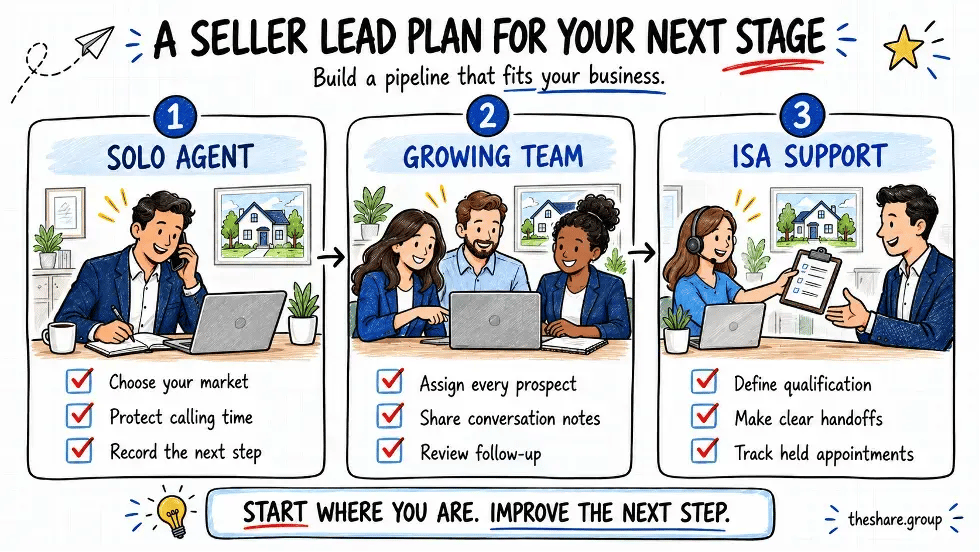
As your business grows, the challenge changes. A solo agent needs time to make calls and follow up. A small team needs clear responsibilities. An ISA-supported operation needs a reliable way to turn conversations into appointments agents can handle.
Your seller lead plan should fit the business you have today and the business you want to build next.
At The Share Group, we help agents think through those decisions: who to target, where to prospect, how much data to work, and how to support the people doing the outreach.
The following framework gives you practical steps for each stage, plus a way to connect your activity to your goals.
Before choosing a list or adding another caller, answer four questions:
Be specific. “Grow my business” gives you little direction. “Create enough qualified seller appointments to support two additional closings per month” gives you something to plan and measure.
A larger team is one possible goal. A productive solo practice with more predictable income is another. Choose the outcome first, then build a lead plan that supports it.
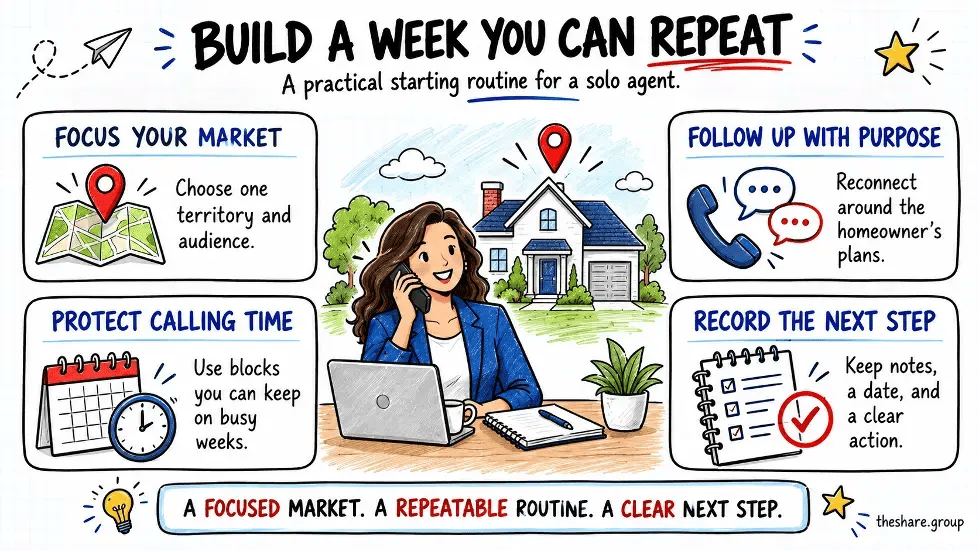
When you manage every part of the transaction, consistency has to fit a real calendar.
Start with an area you know and a homeowner group you can speak to with confidence.
Absentee owners may want to evaluate whether to keep a property, reduce management responsibilities, or explore its value. Homeowners considering downsizing may want to discuss timing, housing options, or the practical work involved in moving.
Those are reasons to ask good questions. Each homeowner’s actual plans should guide the conversation.
A broad list can leave you switching between different messages and markets. A focused campaign gives you an opportunity to learn which questions resonate, what objections arise, and what homeowners want to know.
For a general seller conversation, try an opener like this:
“Hi [First Name], this is [Your Name] with [Brokerage]. I work with homeowners in [Area]. Have you thought about making a move in the next year, or are you planning to stay put?”
For an absentee owner, you might ask:
“Are you planning to keep the property at [Address] long term, or would it be useful to look at what selling could mean?”
Use the answer to decide what to discuss next. A person considering a move may need a pricing conversation. Someone keeping a rental may appreciate a discussion about the property’s performance or future plans.
Choose prospecting blocks you can protect during a busy week. A sample starting routine could be:
Adjust the time to your availability. A schedule you keep is more useful than an ambitious schedule you regularly abandon.
Your list size should support that routine, including repeat attempts and follow-up. Discuss your calling capacity and target market when choosing how much data to buy.
A homeowner who expects to move next spring may become an opportunity through a helpful conversation today.
Ask questions that make the next contact useful:
Record the answer and the commitment. A useful note might read:
Reason: Wants a home with less upkeep. Timing: Considering a move after the next school year. Question: Wants to understand potential net proceeds. Next step: Send a pricing overview Friday and reconnect Tuesday. Responsible agent: [Name].
That note gives you something concrete to do. It also helps the next conversation feel like a continuation.
When someone declines further contact, record and honor that request.
Your next move: Establish a repeatable routine and a clear follow-up process. If those commitments are taking time you need for appointments and clients, consider where support would help.
Adding agents creates capacity and introduces coordination.
Picture this: one agent speaks with a homeowner who may sell in six months. A second agent contacts that same person a week later without knowing about the earlier conversation. Meanwhile, another seller is waiting for a promised pricing review because everyone assumed someone else would send it.
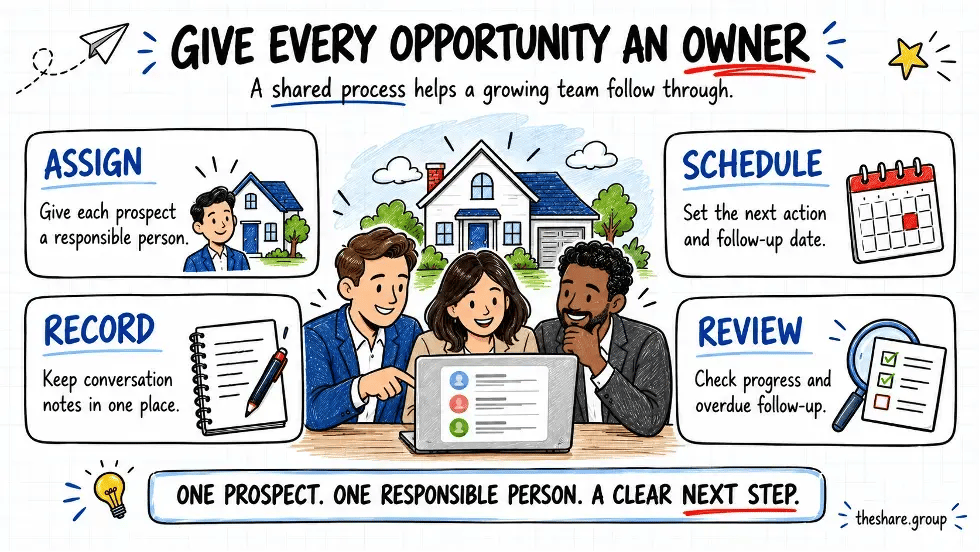
A shared process helps prevent both problems.
Assign prospects by territory, lead type, or available capacity. Make the assignment visible in the system your team uses.
For every homeowner being actively worked, keep a record of:
Check for overlapping assignments before distributing a new list. The same homeowner or property can appear in more than one campaign.
The process should be simple enough for everyone to maintain. If critical information lives in personal notebooks or text threads, another agent will have difficulty continuing the work.
Define the difference between a completed call, an engaged seller prospect, and a qualified appointment.
For example, an engaged seller prospect might be a homeowner who has expressed possible interest in selling, shared relevant timing, and agreed to a next step. A qualified appointment should have a clear purpose the homeowner understands.
Consistent definitions make your numbers more useful. They also help agents know when to keep nurturing a conversation and when to invite the homeowner to meet.
Set aside 15 minutes to review active opportunities and overdue commitments.
Ask which homeowners need attention next, whether promised information has been delivered, and where an agent needs help. Review appointments booked and appointments actually held as separate measures.
Use the meeting to remove obstacles. If conversations are happening but few homeowners agree to a next step, review the questions and offers being used. If good opportunities are waiting on follow-up, address ownership and scheduling.
Your next move: Build a process another person can follow, with a visible owner and next action for each active opportunity.
An inside sales agent, or ISA, can take on prospecting and follow-up so agents can spend more time on appointments and clients.
That arrangement needs clear expectations on both sides. Decide what the caller should accomplish and how the agent continues the conversation.
Specify the territory and audience, the information the caller should gather, and the conditions for involving an agent.
An ISA may uncover someone who is ready to meet, someone who needs information first, or someone who wants to revisit selling later. Decide how each situation should be handled.
The caller’s job includes identifying timing and motivation, recording useful notes, and agreeing on an appropriate next step with the homeowner.
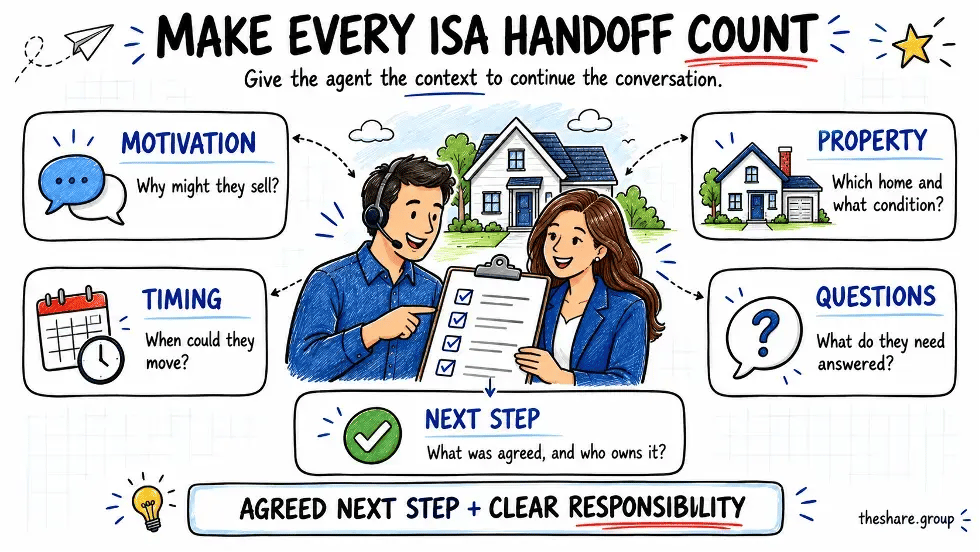
Give the receiving agent enough context to continue without making the homeowner repeat the entire conversation.
A practical handoff includes five things:
Confirm who handles appointment reminders and who follows up if the appointment does not happen. Keep the original conversation notes available to the agent.
Match the lead supply to the team’s actual outreach and follow-up capacity.
Also check whether agents have time to handle the resulting appointments. If callers create opportunities that agents cannot address promptly, increasing outreach adds pressure to an unresolved problem.
Budget for the whole process: data, calling support, tools, training, and agent follow-up. Evaluate the quality of appointments and their eventual outcomes alongside the cost.
Your next move: Establish qualification standards and a dependable handoff, then use actual results to decide where more calling capacity or lead volume would help.
A goal becomes more useful when you translate it into activity.
Start with the seller closings you want, then work backward through signed listings, held appointments, engaged seller prospects, conversations, and dial attempts.
Illustrative planning example: The table below uses hypothetical conversion rates and rounds up at each step. Replace these assumptions with your own measured results.
| Pipeline step | Plan for | Hypothetical planning assumption |
|---|---|---|
| Seller closings | 2 | Your target |
| Signed listings | 3 | 80% of signed listings close |
| Held seller appointments | 5 | 60% of held appointments produce a signed listing |
| Engaged seller prospects | 20 | 25% of engaged prospects reach a held appointment |
| Live conversations | 100 | 20% of conversations produce an engaged seller prospect |
| Dial attempts | 1,000 | 10% of dial attempts produce a live conversation |
With 20 prospecting days, 1,000 dial attempts would average 50 per day under these assumptions.
This gives you a starting point for discussing workload. Your actual rates, call duration, follow-up needs, and available time determine whether that activity level fits your operation.
Calling one homeowner three times creates three dial attempts and uses one contact record.
Plan list size around the number of households you intend to work, repeat attempts, follow-up activity, records you cannot reach, and the lead types available in your market. Daily dial volume alone cannot tell you how many records to purchase.
The homeowners you reach this month may become appointments, listings, or closings in later months.
Track opportunities over time so you can connect eventual results to the outreach that started them. Use a consistent campaign or group of prospects when measuring conversion. Recent conversations and older closings should not be treated as though they all came from the same group.
Review where the process is losing momentum, then choose the improvement most likely to help.
| What you see | What to review |
|---|---|
| Plenty of attempts, few live conversations | Contact information, targeting, and how outreach is handled |
| Conversations, few meaningful next steps | Questions about motivation and timing, plus the value being offered |
| Interested homeowners, overdue follow-up | Responsibility, scheduling, and workload |
| Appointments booked, few appointments held | Qualification, confirmation, and the homeowner’s understanding of the meeting |
| Held appointments, few signed listings | Appointment quality and the listing consultation |
More leads can help when your team has the capacity and process to work them. If the bottleneck is follow-up or appointment handling, address that first.
As the campaign matures, consider cost per held qualified appointment and cost per closing. Divide the campaign costs by the relevant completed outcomes, using consistent cost definitions and the same group of prospects.
These measures can help you evaluate data and staffing decisions in the context of the business they produce.
Choose one market, one primary audience, and a process you can maintain. Use the first month to establish a baseline and improve how you work.
| Week | Focus | Practical action |
|---|---|---|
| 1 | Set the foundation | Choose the audience and territory, define the goal, assign responsibility, and schedule prospecting time. |
| 2 | Start conversations | Track outreach, record homeowner plans, and schedule specific next steps. |
| 3 | Strengthen follow-up | Deliver promised information, review overdue actions, and check appointment or ISA handoffs. |
| 4 | Review and adjust | Identify one bottleneck and make one useful change before expanding the campaign. |
For a solo agent, that change might be protecting an additional calling block. For a team, it might be clarifying assignments. For an ISA operation, it might be improving qualification or appointment confirmation.
The first month’s value includes what you learn about your audience, your capacity, and the process that moves homeowners forward.
The Share Group offers seller lead lists including absentee owners, downsizers and empty nesters, and likely-to-sell homeowners. Every lead includes an owner phone number, and our Lead Shop lets you search for available leads in your market.
Our team can help you think through the audience, geography, and lead volume that fit your prospecting capacity. Whether you are calling on your own, working with other agents, or supporting an ISA team, those choices should reflect how your business operates.
Bring us your target market, who will handle outreach, and what you want to accomplish next. We can use that information to help you choose a practical starting point.
Schedule a free strategy session to discuss your next stage with a seller lead expert.
Ready to explore your market? Create your free Lead Shop account and see which seller leads are available.