
Absentee Owners
An Absentee Owner owns a property but doesn't live there. This term usually refers to owners of vacant properties, not just landlords or rental owners.

Looking for more listing opportunities in today’s market? Downsizers remain one of the most consistent seller segments for agents who know how to approach them the right way.
If you’re looking for more listing opportunities in today’s market, there’s one segment that continues to stand out - downsizers.
These are homeowners who usually do not need to be convinced to sell. They just need clarity, timing, and a plan.
In this guide, we’ll break down why downsizers still matter in 2026, what’s changed in the market, how to approach these conversations, and the scripts and follow-up strategy that can help you turn more of these leads into listings.
One of the biggest shifts happening in real estate today is demographic. Downsizers are not just a niche. They are a major part of the seller market.
Many of these homeowners have lived in their home for years, built substantial equity, and reached a stage of life where their priorities are changing. They may want to be closer to family, reduce upkeep, simplify their lifestyle, or move into a home that better fits their next chapter.
That is what makes downsizer leads so valuable. These are often life-driven decisions, not just market-driven decisions.
When you approach them the right way, the conversation becomes much easier.
Downsizer leads are still strong, but the way agents need to work them has changed.
A lot of downsizers are in the planning phase long before they are in the transaction phase. That means you cannot rely on one call, one voicemail, or one email and expect results.
This is a slower decision cycle, and the agents who win here are the ones who stay consistent and helpful.
Many agents still assume older homeowners only answer landlines. That is no longer a safe assumption.
Today, plenty of homeowners in this age group are using mobile phones as their primary line, which means your outreach needs to feel more natural, more concise, and more trust-based.
That is why shorter call openers, simple permission-based texts, and clear value offers matter more than ever.
A lot of potential downsizers are unsure what to do because they are comfortable with their current mortgage and uncertain about what comes next.
Instead of trying to push past that concern, strong agents guide the conversation toward clarity. They help homeowners understand their options, their equity, and what a move could realistically look like.
NAR (Ages 70-78): Top reasons for selling (Primary reason)
Move closer to friends/family 36% | ####################################
Home is too large 16% | ################
Upkeep too difficult 9% | #########
Source: NAR 2025 Generational Trends Report (Exhibit 6-13)
Most downsizer conversations come back to the same few motivations. Once you understand them, your scripts become much more natural.
Some homeowners are thinking less about the house itself and more about where they want to be. They may want to be near children, grandchildren, close friends, or support systems.
This is one of the most common signals. The issue is not always emotional. Sometimes it is practical. Too many rooms, too much yard work, stairs, cleaning, or unused space.
Repairs, taxes, insurance, and maintenance all create friction. For a lot of downsizers, the real question is not “Should we sell?” It is “How do we make this easier?”
That is why your messaging should focus on planning and simplification, not just listing a home.

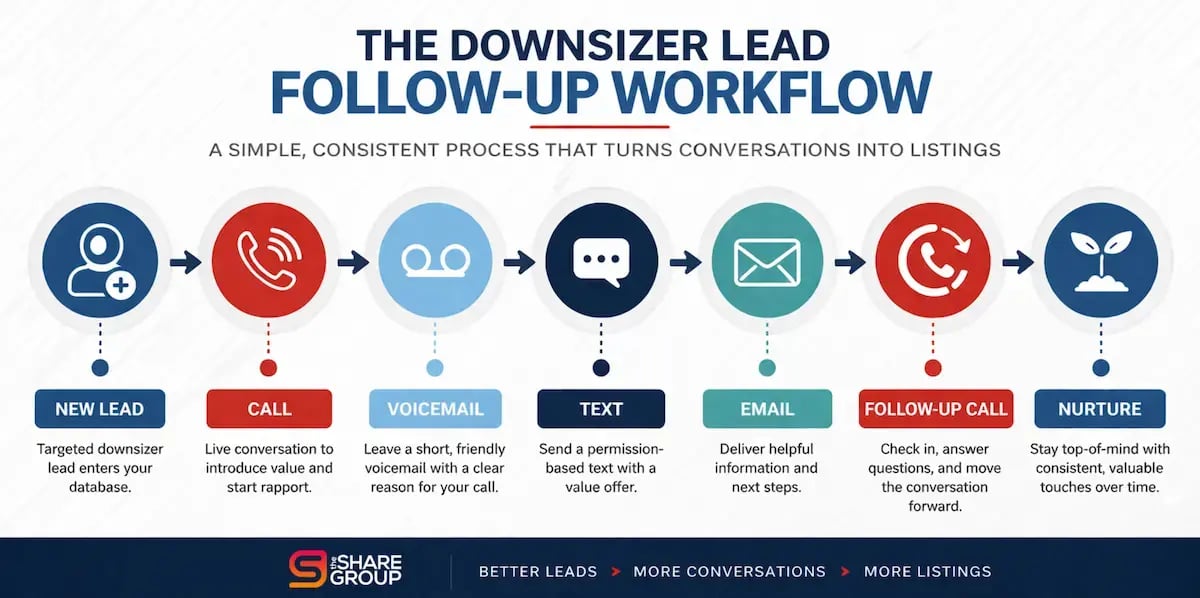
One script is not enough anymore. The best agents use a system that includes calls, voicemail, text, and email.
Agent: Hi, is this [Homeowner Name]?
Agent: Hi [Name] - my name is [Your Name] with [Brokerage]. I know this is out of the blue.
Agent: The reason I’m calling is I’m helping a few homeowners in [Neighborhood] map out a move closer to family plan this year.
Agent: Quick question - if the right option existed, is that something you’d consider in the next 12 months?
This works because it opens with a real life-stage motivation and feels more like guidance than a sales pitch.
Agent: Hi, is this [Homeowner Name]?
Agent: Hi [Name], this is [Your Name] with [Brokerage]. I’ll be brief.
Agent: A lot of long-time homeowners tell me they love their home, but it’s starting to feel like too much house - stairs, yard, repairs, or just rooms that don’t get used.
Agent: Have you felt that at all, or are you still in the we’re fine for now stage?
This one works well because it feels relatable and non-threatening. It invites honesty instead of resistance.
Hi [Name], it’s [Your Name] with [Brokerage]. I put together a quick downsizing options snapshot for homeowners in [Neighborhood]. If that’s something you’d ever want, I’d be happy to send it over. You can call or text me at [Number].
Hi [First Name] - this is [Your Name], a local Realtor in [City]. I’m putting together a quick downsizing plan for a few homeowners nearby. Would it be okay if I texted it to you? Reply YES and I’ll send it.
Subject: A simple downsizing plan for [Neighborhood]
Hi [Name],
Many long-time homeowners in [Neighborhood] are thinking about one of three things - moving to a smaller home, relocating closer to family, or getting clarity on costs before making a decision.
If that sounds even a little familiar, I can send you:
Want me to send it over?
The right scripts matter, but they work a lot better when you start with the right data.
Search for Downsizer Leads in Your MarketThese are written as practical playbooks you can actually use. Adjust timing based on your local regulations, DNC status, and consent.
Day 0
Day 1
Day 3
Day 6
Day 10
Day 14
Day 0
Day 1
Day 2
Day 5
Day 8
Day 12
Why this works:
The downsizing conversation is both emotional and logistical. Most homeowners are not just thinking about selling - they are thinking about how to transition without stress. A plan-first approach builds trust and keeps the conversation moving.
Day 0
Day 1
Day 3
Day 6
Day 9

Response:
“That’s completely fair. My goal isn’t to rush you. It’s to give you a plan so you stay in control. Would it help if I sent a simple checklist and checked back next month?”
Response:
“That’s actually the first step. We can narrow down what your next home should look like before making any big decisions. That’s where most people start.”
Response:
“Rates are real. That’s why we should look at both scenarios - staying vs moving. Some downsizers actually reduce their financial risk by buying smaller or using equity. If waiting makes more sense, you’ll know.”
Response:
“That’s more common than people admit. The good news is you don’t have to solve it all at once. There are simple ways to break it down and make it manageable.”
Response:
“If it makes sense down the road, I’d love the opportunity. But right now, the goal is just to give you clarity and options. No pressure.”
Response:
“Understood. I’ll update my records right away. Before I go, would you prefer email only, or no contact at all?”
A lot of downsizer opportunities are lost not because of bad data, but because the follow-up ends too early.
Downsizer leads often need time. That means your system should feel helpful, patient, and consistent.
The goal is not to pressure someone into listing. The goal is to become the obvious person to call when they are ready.
That is completely normal. A better response is: “That makes sense. Most people aren’t ready right away. That’s why the first step is usually just a plan.”
This is often the real concern. You can respond with: “That’s actually where I usually help people start - narrowing down what the next home should look like before making any major decision.”
Rather than debating the point, offer clarity: “That’s exactly why it helps to run the numbers. Sometimes the move still makes sense, and sometimes waiting does. Either way, you’ll know.”
This is very common. A calm response works best: “That’s normal. A lot of people feel that way. The good news is you do not need to solve it all at once.”
Downsizers usually do not respond well to pressure. They respond to guidance, trust, and clarity.
When you stop trying to force urgency and start helping people think through their next step, the conversation changes. It feels more natural, and you become more valuable.
Even the best scripts will struggle if the data is weak.
If downsizers are part of your listing strategy, it helps to target homeowners with the right profile:
Better targeting gives your outreach a much better chance of landing with the right person at the right time.
If you want to use this strategy in your business, start with better data and a more consistent system.
The Share Group helps agents target seller opportunities with data built for real prospecting conversations.
Search Downsizers in Your Zip CodeDownsizers are one of the most consistent listing opportunities available to agents right now, but they need to be handled the right way.
This is not about pushing a script harder. It is about understanding the real motivations behind the move, offering a plan, and following up with enough consistency to stay relevant when the timing is right.
Do that well, and downsizer leads can become one of the strongest pillars of your listing business.
Yes. They remain one of the most consistent seller segments because the motivation is often tied to life changes, not just market conditions.
A good starting point is 6 to 8 touches over the first few weeks, then moving into longer-term nurture.
That depends on your process and compliance approach, but in most cases a call plus a simple follow-up text works well.
They treat the opportunity like a quick sale instead of a longer planning process.
Need help reaching more sellers? The Share Group provides targeted lead data built to help agents find real listing opportunities and start more conversations with the right homeowners.