
Absentee Owners
An Absentee Owner owns a property but doesn't live there. This term usually refers to owners of vacant properties, not just landlords or rental owners.

Real estate agents do not need more random names in their database.
They need better seller opportunities.
That distinction matters more in 2026 than it did a few years ago. The market is no longer the red-hot, list-it-and-sell-it environment agents experienced during the pandemic boom. At the same time, it is not completely frozen either. Inventory has improved in many markets, mortgage rates are still elevated, affordability remains tight, and homeowners are being more selective about when and why they move.
For agents, that creates a very specific challenge.
You cannot just wait for obvious sellers to raise their hands. By the time a homeowner fills out a form, talks to three agents, or starts browsing home valuation websites, competition is already high. The agents who win more listings in 2026 will be the ones who identify seller intent earlier and build relationships before the homeowner is actively shopping for representation.
That is why the best seller lead types for 2026 are not based on gimmicks. They are based on life stage, property situation, equity, ownership patterns, and probability of movement.
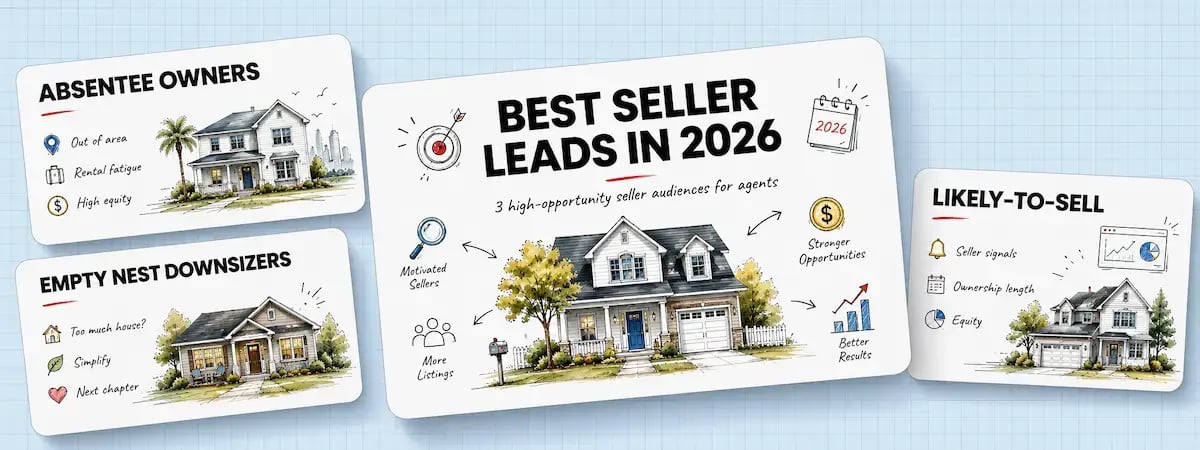
If you want to grow your listing pipeline this year, three lead types should be at the top of your prospecting strategy:
Each one gives agents a different angle into the seller market. Used together, they create a balanced prospecting plan that helps you find owners who may have a reason to sell, even if they have not raised their hand yet.
For years, many agents relied heavily on inbound leads, referrals, open houses, and online buyer inquiries. Those still matter, but they are not enough in a market where affordability is limiting buyer activity and many homeowners are reluctant to give up a lower mortgage rate.
In 2026, the agents who stay consistent with outbound seller prospecting have an advantage.
The reason is simple: most homeowners do not decide to sell overnight.
A seller may think about moving for months before taking action. A landlord may be tired of managing a property long before they list it. An empty nester may know the house is too big but delay the decision because the move feels overwhelming. A homeowner with strong equity and long tenure may be quietly considering a move but waiting for the right timing.
These are not always “hot leads” in the traditional internet lead sense. They are better described as opportunity leads.
The goal is not to call someone once and ask, “Do you want to sell?” The goal is to identify the right homeowners, start a relevant conversation, provide useful market insight, and stay in touch until timing lines up.
That is why seller data matters.
The right list can help you focus on homeowners who are more likely to have a real reason to move. Instead of prospecting an entire city blindly, you can prioritize owners based on property use, life stage, equity, ownership length, and market behavior.
That brings us to the three best seller lead types for real estate agents in 2026.

Absentee homeowner leads continue to be one of the strongest seller lead types for real estate agents because the owner does not live in the property.
That one detail changes the entire conversation.
An absentee owner may own a rental property, inherited property, second home, vacant home, or former primary residence. Some are experienced investors. Others never planned to become landlords and are simply holding onto a property because they did not know what else to do with it.
In either case, absentee owners are different from traditional owner-occupants.
They may be more financially motivated. They may be more open to discussing property value, equity, rent performance, maintenance costs, tax implications, or whether now is the right time to sell.
The 2026 market creates several reasons absentee owners may be willing to have a conversation.
First, many rental property owners have benefited from years of appreciation. They may be sitting on strong equity but dealing with higher insurance costs, repairs, taxes, tenant issues, or property management fatigue.
Second, some owners are looking at their return on equity and realizing the property may no longer be the best use of their money. If the home has appreciated significantly, selling could free up cash for another investment, retirement goal, debt reduction, or a simpler lifestyle.
Third, the rental market is not equally strong everywhere. Some landlords are doing well, while others are dealing with more competition, slower rent growth, higher expenses, or changing local regulations.
That creates an opening for agents who know how to approach the conversation correctly.
Instead of leading with, “Do you want to sell?” a stronger approach is:
“Are you still planning to hold onto the property long term, or would it be helpful to see what it may be worth in today’s market?”
That question is softer, more relevant, and more likely to start a real conversation.
Not all absentee owners should be treated the same. For better results, agents should segment absentee homeowner leads based on the situation.
Some of the best absentee owner segments include:
The most important thing is to match your message to the likely motivation.
An out-of-state owner may care about convenience. A tired landlord may care about reducing hassle. An investor may care about return on equity. An inherited property owner may care about options and timing.
Absentee owner prospecting works best when it feels consultative.
Your message should not sound like every investor postcard they have already received. Real estate agents have an advantage because they can bring market knowledge, pricing strategy, and a full-service path to selling.
Here are a few message angles that work well:
Property value angle:
“Home values in your property’s area have changed quite a bit. Would it be helpful to see an updated value range?”Rental fatigue angle:
“A lot of rental owners are reviewing whether it still makes sense to hold or sell. Are you planning to keep this property long term?”Equity angle:
“You may have more equity in the property than you realize. I can send over a quick estimate if you want to compare your options.”
Maintenance angle:
“Some owners are choosing to sell instead of putting more money into repairs or updates. Is that something you have considered?”
The key is to lead with options, not pressure.
Absentee owners may not be ready today, but they are one of the best groups to nurture because the property is already separate from their primary residence. That can make the selling decision easier when the timing is right.
Empty nest downsizer leads are another powerful seller lead type for 2026 because they are based on a major life-stage shift.
These homeowners often bought a larger home when they were raising a family. Years later, the kids are out of the house, the home is bigger than they need, and the maintenance may feel like more work than it is worth.
But downsizing is not just a financial decision.
It is emotional.
For many empty nesters, the home is tied to family memories, holidays, milestones, and identity. That is why agents need to approach this audience with more care than a standard sales pitch.
Empty nesters are important because many own larger homes that younger families desperately want.
At the same time, many of these homeowners are staying put longer than previous generations. Some are locked into low mortgage rates. Others do not know where they would move. Some are concerned about the cost of buying again, while others simply do not want to deal with the stress of selling, packing, and relocating.
That hesitation creates opportunity for agents who can be patient and helpful.
The best agents do not push empty nesters to sell. They help them understand their options.
For example:
These are meaningful conversations.
The strongest downsizer leads usually combine age, home size, equity, and length of residence.
Good targeting criteria may include:
This is where data becomes valuable. A generic neighborhood mailer may reach everyone, but a targeted downsizer list lets an agent focus on homeowners who are more likely to be entering a new phase of life.
Empty nester marketing should be respectful, useful, and low pressure.
Do not make the homeowner feel old. Do not make it sound like they need to leave their home. Do not lead with fear.
Instead, lead with curiosity and planning.
Strong message angles include:
Lifestyle angle:
“Have you thought about whether your current home still fits the lifestyle you want over the next 5 to 10 years?”
Equity angle:
“Many long-term homeowners are surprised by how much equity they have. Would it be useful to see a current estimate?”
Low-maintenance angle:
“A lot of homeowners are exploring lower-maintenance options without feeling rushed. I can send over a few examples if that would be helpful.”
Planning angle:
“Even if you are not ready to move now, it may help to know what your options look like.”
For empty nesters, the first conversation may not be about listing the home.
It may be about clarity.
That is why these leads are so valuable. Once an agent becomes the trusted advisor during the planning phase, they are far more likely to be the first call when the homeowner decides to sell.
Likely-to-sell homeowner leads are different from absentee owners and downsizers because they are built around predictive signals.
Instead of focusing on one simple category, likely-to-sell data uses multiple indicators to identify homeowners who may have a higher probability of moving.
These indicators can include things like ownership length, equity, property characteristics, neighborhood turnover, life-stage factors, mortgage information, home value trends, and other data points that may suggest a homeowner is more likely to sell.
In a market where obvious sellers are heavily targeted, predictive seller leads can help agents get upstream.
The biggest challenge in 2026 is timing.
Many homeowners have a reason to move, but they are cautious. They may be waiting for rates to improve, waiting for the right home to buy, waiting for kids to finish school, waiting for retirement, or waiting to see what happens in the market.
Likely-to-sell leads help agents identify homeowners who may be closer to a move than the average person.
That does not mean every lead is ready to list immediately. It means the list gives you a smarter starting point.
Instead of calling every homeowner in a zip code, you can prioritize homeowners who show a stronger combination of seller signals.
That matters because prospecting is a numbers game, but it should not be a random numbers game.
Better targeting helps agents make more relevant calls, send better mailers, create stronger follow-up campaigns, and spend less time chasing people who are unlikely to move.
A likely-to-sell model may consider several categories of data, such as:
The power is not in any single data point. The power is in the combination.
For example, a homeowner who has owned the property for 15 years, has strong equity, lives in a high-demand neighborhood, and fits a common life-stage pattern may be a better prospect than a homeowner who bought two years ago with little equity.
The best way to market to likely-to-sell homeowners is to lead with timely, local insight.
These homeowners may not see themselves as “leads.” They are simply homeowners who may be approaching a decision point. Your job is to give them a reason to engage.
Strong message angles include:
Market update angle:
“Homeowners in your area are asking whether 2026 is a good time to sell. I put together a quick local update if you would like a copy.”
Equity angle:
“You may have built significant equity over the past several years. Would it help to see a current value range?”
Timing angle:
“A lot of homeowners are not sure whether to move now or wait. I can walk you through what is happening locally so you can compare your options.”
Buyer demand angle:
“There is still demand for homes like yours in your area, especially when pricing is realistic. Would you like to know what buyers are currently looking for?”
Likely-to-sell leads are especially effective when combined with consistent follow-up. One call or one postcard is rarely enough. The goal is to stay visible and relevant until the homeowner is ready.
The strongest seller prospecting strategy does not rely on only one lead type.
Absentee owners, empty nesters, and likely-to-sell homeowners each serve a different purpose in your pipeline.
Absentee owners are valuable because the property is not the owner’s primary residence. That often creates a more practical, numbers-based selling conversation.
Best for:
Empty nesters are valuable because their current home may no longer match their lifestyle. This is a long-term relationship play that rewards patience and trust.
Best for:
Likely-to-sell leads are valuable because they help you prioritize homeowners who may be closer to a move based on multiple data signals.
Best for:
When used together, these three lead types give agents a more complete seller prospecting system.
You are not just hoping someone raises their hand. You are identifying owners with a reason to move, reaching out with a relevant message, and staying in front of them until timing matches motivation.
Buying a seller lead list is not the strategy.
Working the list is the strategy.
The agents who get results from seller data usually do a few things consistently.
Your results depend heavily on the quality of the data. A good seller list should include accurate owner information, property details, mailing address, phone numbers, emails when available, and useful filters like equity, age, home value, ownership length, and occupancy status.
The more targeted the list, the easier it is to create a relevant message.
Do not send the same message to every homeowner.
An absentee owner should not receive the same message as an empty nester. A high-equity owner should not receive the same message as someone who bought recently. A likely-to-sell homeowner in a hot neighborhood may need a different angle than one in a slower market.
Segmentation improves the conversation.
Some homeowners answer the phone. Some respond to mail. Some reply to email. Some need to see your name several times before they engage.
A strong seller outreach plan may include:
The goal is not to overwhelm people. The goal is to be consistent and recognizable.
Most homeowners are not waiting for an agent to ask if they want to sell.
They are more likely to respond when the message helps them understand something useful:
Value creates trust. Trust creates conversations. Conversations create listings.
Many seller leads are future opportunities.
That does not make them bad leads. It means the agent needs a follow-up system.
A homeowner who is not ready in February may be curious in June. A landlord who says “not right now” may change their mind after a repair bill. An empty nester may attend an open house six months later and start thinking seriously about moving.
The fortune is still in the follow-up.
The best seller leads for real estate agents in 2026 are not random homeowners.
They are homeowners with a reason to talk.
Absentee owners may be ready to simplify, cash out, or rethink their rental property. Empty nest downsizers may be ready to explore a home that better fits their next phase of life. Likely-to-sell homeowners may be showing data signals that suggest a move could be coming.
These three lead types give agents a smarter way to build listing inventory in a market where waiting for referrals and inbound leads is not enough.
If you want more listings in 2026, focus your prospecting on homeowners who have a reason to move, a reason to listen, and a reason to remember your name when the timing is right.
The Share Group helps real estate agents and investors find high-quality seller leads, including absentee homeowners, empty nest downsizers, and likely-to-sell homeowners. With accurate data, targeted filters, and seller-focused lead lists, agents can spend less time guessing and more time starting real conversations with the right homeowners.
Ready to find seller leads in your market?
Create a free Lead Shop account, search your area, and see how many absentee owner, downsizer, and likely-to-sell leads are available near you.
If you want access to targeted homeowner data built around these exact segments - including absentee owners, downsizers, and likely-to-sell homeowners - you can explore available leads in your area inside the Lead Shop.
Or reach out and we’ll help you identify the best opportunities based on your market.