
Absentee Owners
An Absentee Owner owns a property but doesn't live there. This term usually refers to owners of vacant properties, not just landlords or rental owners.

Most real estate agents think about absentee owner leads in one simple way:
“This person owns a property they do not live in. Maybe they want to sell.”
That is true, but it is also too limited.
Absentee owners are one of the most versatile lead types in real estate because they can create several different opportunities from a single conversation. An absentee owner might want to list the property. They might be open to a cash offer. They might be interested in buying another investment property. Their tenant might be looking for a home. Or they may simply need a trusted local agent to help them understand what the property is worth in today’s market.
That is why absentee owner seller leads deserve a serious place in your prospecting plan.

In a market where inventory is still tight, affordability remains challenging, and many homeowners are not actively raising their hands, agents need lead sources that create conversations before someone becomes a public listing. Absentee owners can do exactly that.
According to NAR, April 2026 existing-home sales were running at a 4.02 million annual pace, with a median sales price of $417,800 and 4.4 months of inventory. In other words, there are still transactions happening, but agents need to be more intentional about finding motivated opportunities before every other agent is chasing the same listing.
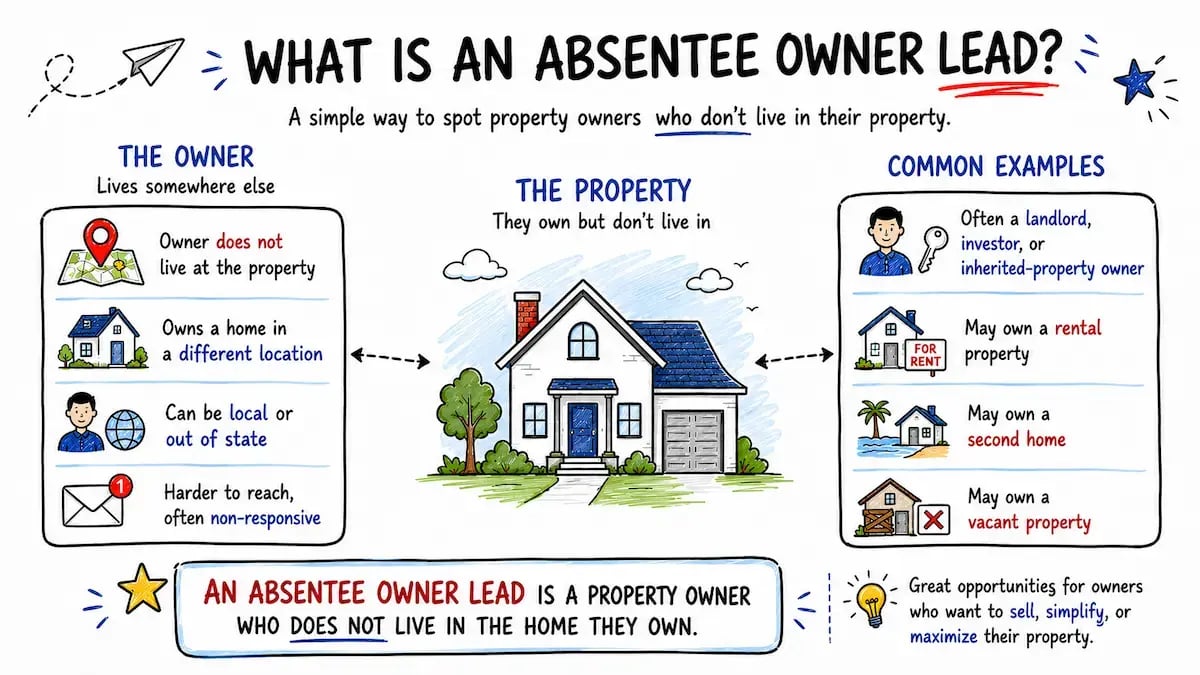
An absentee owner is a property owner who does not live in the property they own.
That could include:
For real estate agents, absentee owner leads are valuable because they represent a group of homeowners who may have less emotional attachment to the property than someone living in their primary residence. They may also be dealing with the practical realities of ownership: tenants, repairs, vacancy, taxes, insurance, property management, and shifting market conditions.
That does not mean every absentee owner wants to sell. Many do not. But it does mean the conversation can go in more than one direction.

The biggest mistake agents make with absentee owners is treating them like a one-dimensional lead.
A typical seller lead campaign might ask:
“Do you want to sell your property?”
That can work, but it leaves a lot of opportunity on the table.
A better absentee owner campaign asks:
“What is the best use of this property for you right now?”
That question opens the door to a much broader conversation. The owner may be happy with the rental income. They may be tired of managing tenants. They may be curious about selling but unsure what the property is worth. They may want to exchange into another investment. They may be open to a cash offer if the process is simple. They may know the tenant is looking to buy.
That is the real strength of absentee owner prospecting: the first contact does not have to produce only one possible outcome.
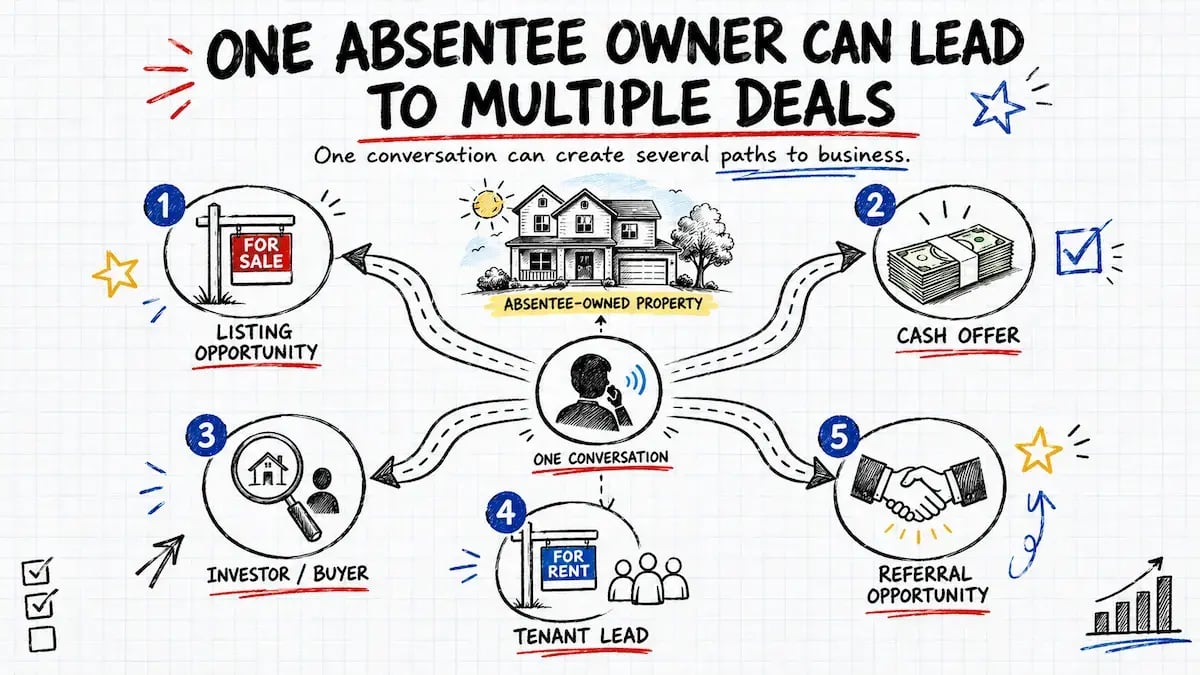
This is the part that tends to catch agents’ attention.
One absentee owner lead can potentially create multiple deal paths:
This is the most obvious opportunity.
An absentee owner may be ready to sell because the property no longer fits their goals. Maybe the rent is not keeping up with expenses. Maybe they are tired of maintenance. Maybe the property has appreciated and they want to cash out. Maybe they live too far away to manage it effectively.
This is especially relevant when rental property ownership becomes more expensive. Insurance, property taxes, repairs, and vacancy can all change the return on investment.
The U.S. Census Bureau reported a national rental vacancy rate of 7.3% in the first quarter of 2026, which means vacancy is still a real factor for rental property owners to consider.
Not every absentee owner wants a traditional listing process.
Some want speed. Some want certainty. Some do not want to repair the property, coordinate showings, deal with tenants, or wait for buyer financing.
That is where a cash offer conversation can make sense.
For agents and investors, absentee owners are often a natural fit for cash offer outreach because the owner may be more focused on convenience, timing, and net proceeds than the emotional side of selling a personal home.
The key is not to assume distress. Many absentee owners are not distressed at all. The better approach is to position the cash offer as one possible option:
“Would it be helpful to compare what you could get through a traditional listing versus a direct cash offer?”
That creates a consultative conversation instead of a pushy sales pitch.
This is where many agents miss the upside.
An absentee owner is not just a potential seller. They may also be an investor.
If they already own one rental property, they may want to own more. They may be interested in upgrading their portfolio, moving into a better market, buying a different type of property, or exchanging into a more manageable asset.
Investor activity remains a meaningful part of the housing market. Cotality reported that investors accounted for 32% of single-family home purchases in January 2025 and 29% in June 2025, with investor purchases averaging about 85,000 homes per month in the first half of 2025.
That matters for agents because absentee owner outreach can lead to a conversation about more than selling one property. It can lead to long-term investor relationships.
This is another overlooked angle.
If the property is tenant-occupied, the tenant may eventually need a place to live. They may want to buy. They may need another rental. They may be moving soon. They may know the owner is thinking about selling.
Of course, tenant communication needs to be handled carefully and professionally. But from a lead generation perspective, an absentee-owned property can create more than one relationship:
That is why absentee owner leads are so powerful. You are not just buying a name. You are creating a connection to a property situation.
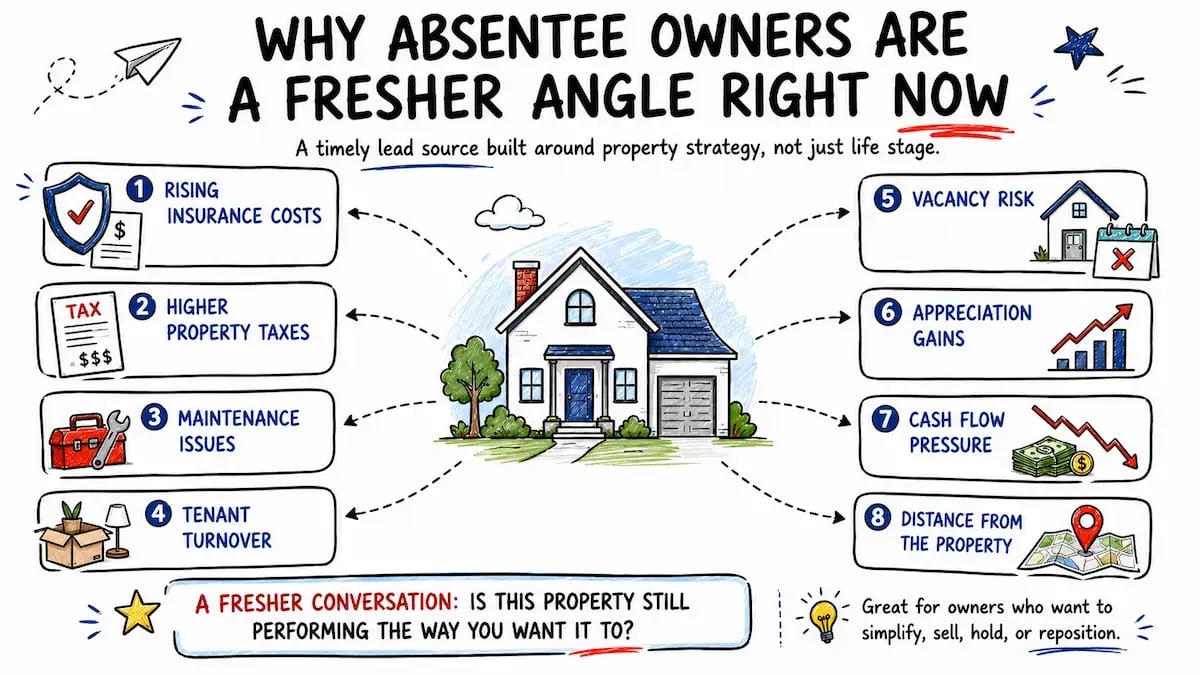
A lot of real estate content focuses on downsizers, empty nesters, and homeowners sitting on equity. Those are strong lead categories, but absentee owners give agents a different story to tell.
They are less about life stage and more about property strategy.
Instead of asking, “Are you ready to downsize?” the agent can ask:
“Is this property still performing the way you want it to?”
That question is relevant in almost every market.
Absentee owners may be looking at:
This creates a timely and practical reason to reach out.
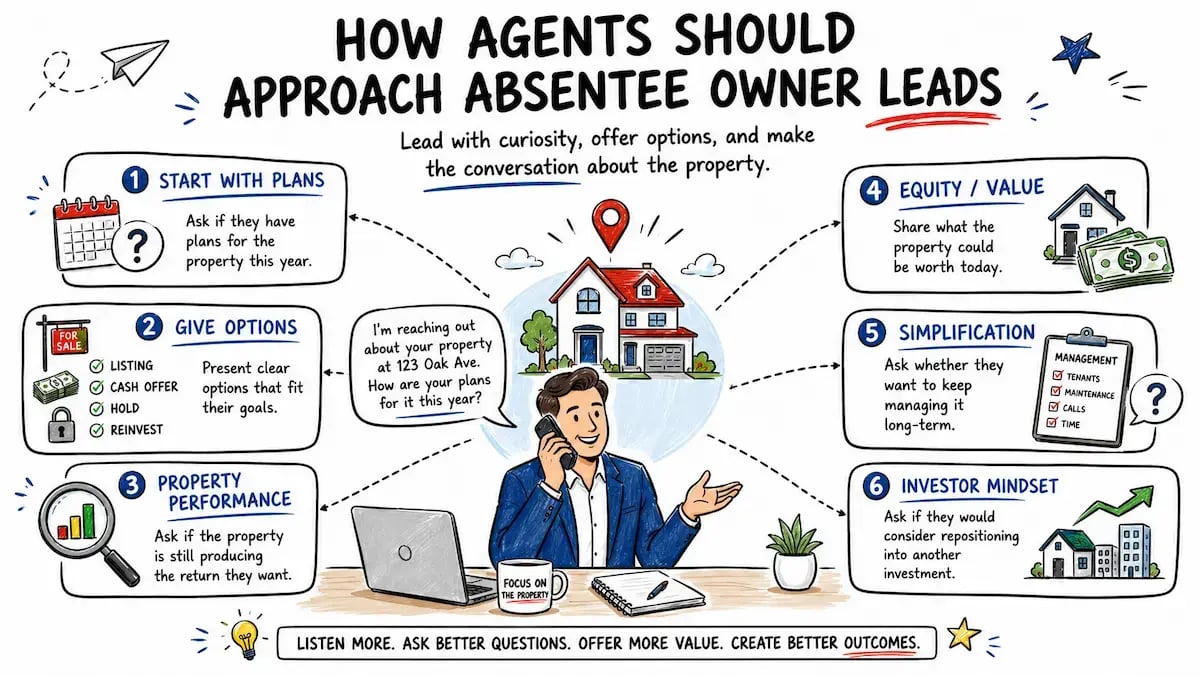
The best absentee owner campaigns do not sound like generic seller spam.
A strong message is specific, local, and useful.
Instead of:
“Do you want to sell your house?”
Try:
“I was looking at absentee-owned properties in [area] and wanted to see if you have any plans for the property this year. Some owners are holding, some are selling, and some are just curious what the numbers look like in today’s market.”
This approach works because it gives the owner options. It does not force them into a yes-or-no seller conversation.
Here are a few angles agents can test.
This works well for landlords and investors.
“Is the property still producing the return you want, or would it be worth looking at your options?”
This works well when the property has likely appreciated.
“A lot of owners in the area have more equity than they realize. Would it be helpful to see what your property could sell for in today’s market?”
This works well for tired landlords or out-of-area owners.
“Are you planning to keep managing the property long-term, or would you consider selling if the numbers made sense?”
This works well when the owner values options.
“Would you want to compare a traditional listing value against a possible cash offer so you can see both paths?”
This works well when the owner may want to grow or reposition.
“Are you looking to hold this property long-term, or are you considering moving into a different investment?”
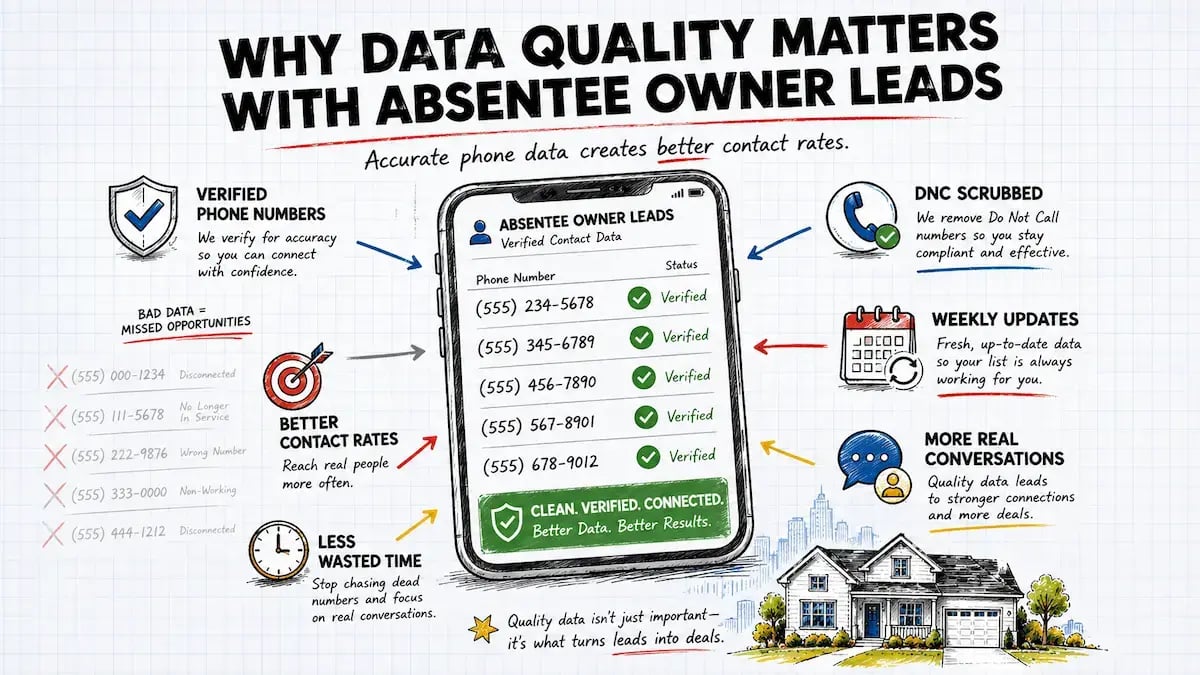
Absentee owner prospecting is only as good as the data behind it.
Agents need accurate property ownership records, mailing addresses, phone numbers, and filters that help prioritize the right owners. Without good data, agents waste time calling disconnected numbers, chasing bad records, or reaching people who do not match the campaign.
The best absentee owner lists should allow agents to narrow their focus by factors like:
This is where a targeted lead source can make a major difference. Instead of calling every homeowner in a ZIP code, agents can focus on owners who have a specific property situation that makes the conversation more relevant.
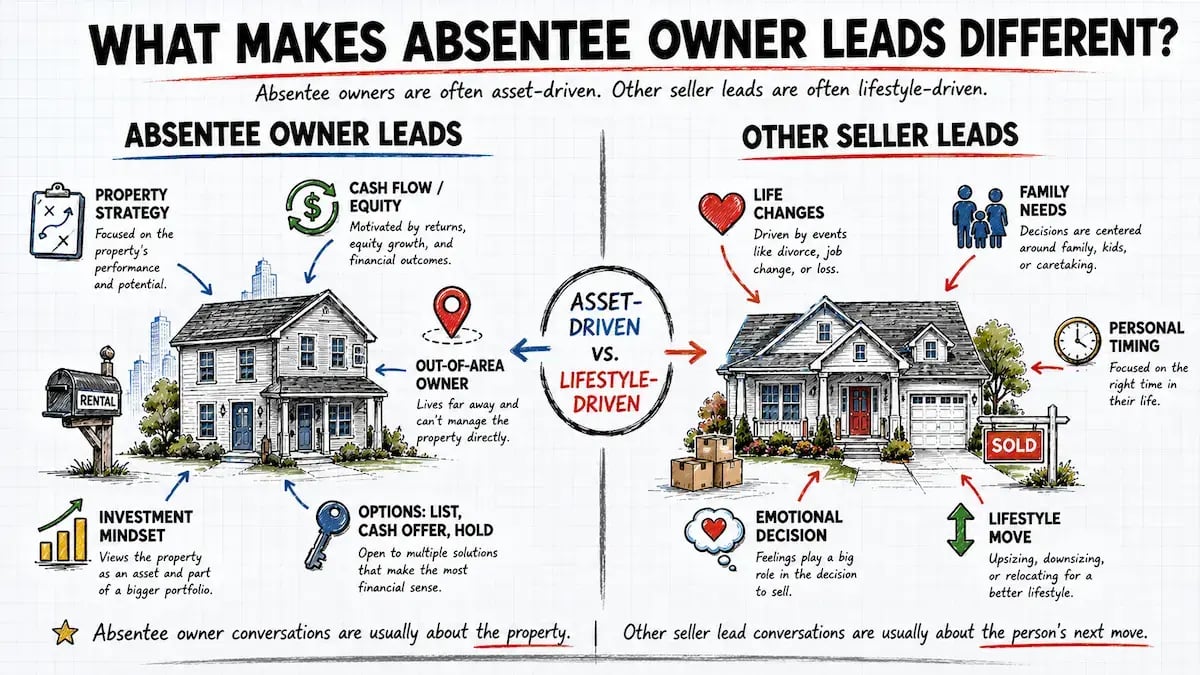
Absentee owners are different because motivation is often tied to the asset, not the owner’s personal living situation.
With a downsizer, the conversation may be about lifestyle, family, space, maintenance, or retirement.
With an absentee owner, the conversation is usually about strategy:
That makes absentee owner leads especially useful for agents who are comfortable having investment-minded conversations.
You do not have to be a full-time investment specialist, but you should be ready to talk about value, rent, equity, net proceeds, timing, and options.
Here is a simple framework agents can use:
“Hi [Name], this is [Agent Name]. I know you own the property on [Street Name], but it looks like you may not live there. I work with owners in the area and just wanted to see if you have any plans for that property this year.”
If they say they are keeping it:
“That makes sense. Is it currently a rental, or are you holding it for another reason?”
If they say it is a rental:
“Got it. Are you happy with how it is performing, or would you ever consider selling or repositioning into something else?”
If they ask why you are calling:
“A lot of absentee owners are reviewing their options right now. Some are holding, some are selling, and some just want to know what the property is worth. I wanted to see where you are with it.”
If they are open to a conversation:
“I can put together a quick look at what the property may be worth, what it could sell for traditionally, and what a simpler cash offer route might look like. Then you can compare options.”
The goal is not to pressure the owner. The goal is to start a useful conversation.
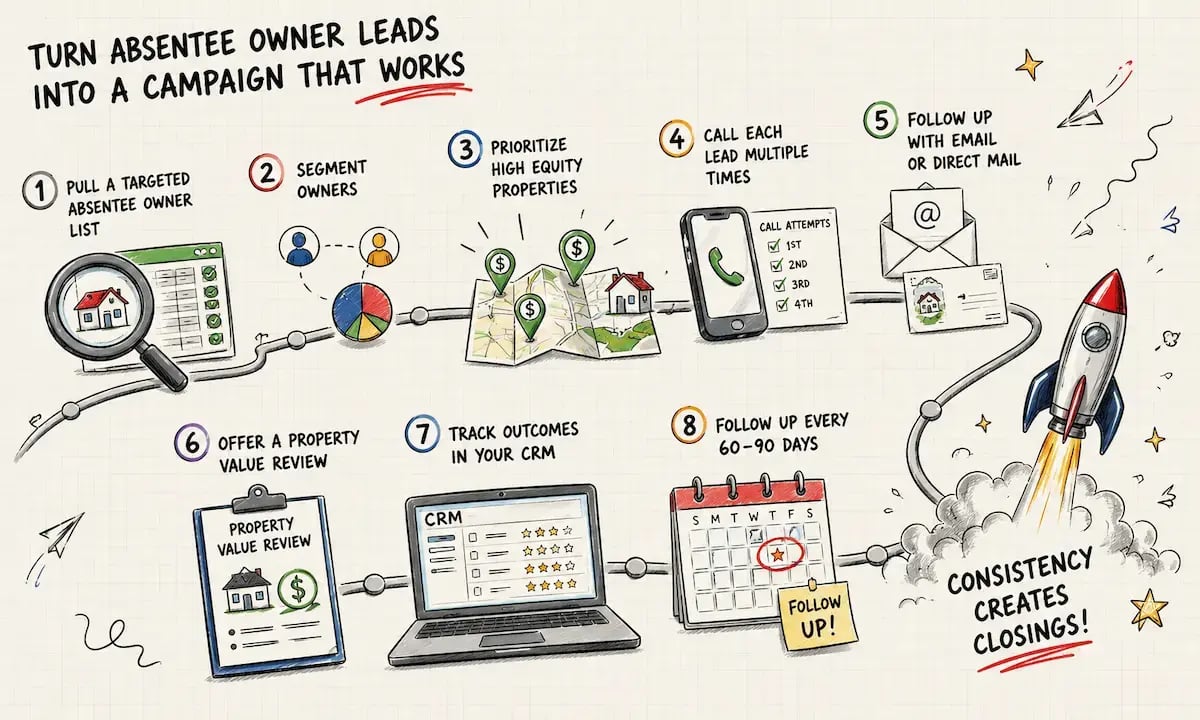
A strong absentee owner campaign should include multiple touches.
A good starting plan might look like this:
The follow-up is important because many absentee owners are not immediate sellers. They may need a lease to end. They may need a repair issue to come up. They may need tax advice. They may need the right market conditions.
The agent who stays in touch has the advantage when that owner finally decides to make a move.

Absentee owner leads are one of the most flexible lead types for real estate agents because the opportunity is not limited to one outcome.
An absentee owner might:
That is why absentee owner prospecting should not be treated as a basic seller list. It should be treated as a relationship-building campaign around property ownership, investment strategy, and timing.
When you approach absentee owners with the right message, the conversation becomes much bigger than, “Do you want to sell?”
It becomes:
“What is the best move for this property?”
And that is where real opportunities start.
If you want access to targeted homeowner data built around these exact segments - including absentee owners, downsizers, and likely-to-sell homeowners - you can explore available leads in your area inside the Lead Shop.
Or reach out and we’ll help you identify the best opportunities based on your market.